November 2026 · Strategic Perspective · By Hansel Boyd
A convincing AI-generated shot can win attention in seconds. A film release asks for something harder: an audience willing to stay, a story that holds together, and a record of how the work can be shown, shared, and licensed.
In November 2026, I believe the central question in AI cinema is changing. We have spent enormous energy proving that images can be made. Now we need to prove that completed works can travel beyond a demo reel—into festivals, online platforms, living rooms, and serious commercial conversations.
The difference between an impressive sequence and a releasable film is not simply resolution, runtime, or the number of tools used. It is readiness.
The rules are becoming part of the creative conversation
Look at the different requirements now appearing around films that use AI. The World AI Film Festival USA’s rules, updated November 13, 2026, call for a production journal identifying AI tools and set explicit expectations for disclosure, likeness and voice consent, music clearance, and a named creative lead. The YouTube changes announced in May 2026 made labels for realistic AI-generated or significantly altered footage more prominent and introduced automated labeling signals.
These are not identical rules, and they do not govern every screening or platform. But they point to a common reality: filmmakers are increasingly asked to explain not only what appears on screen, but how it got there and whether it is ready for the audience that will encounter it.
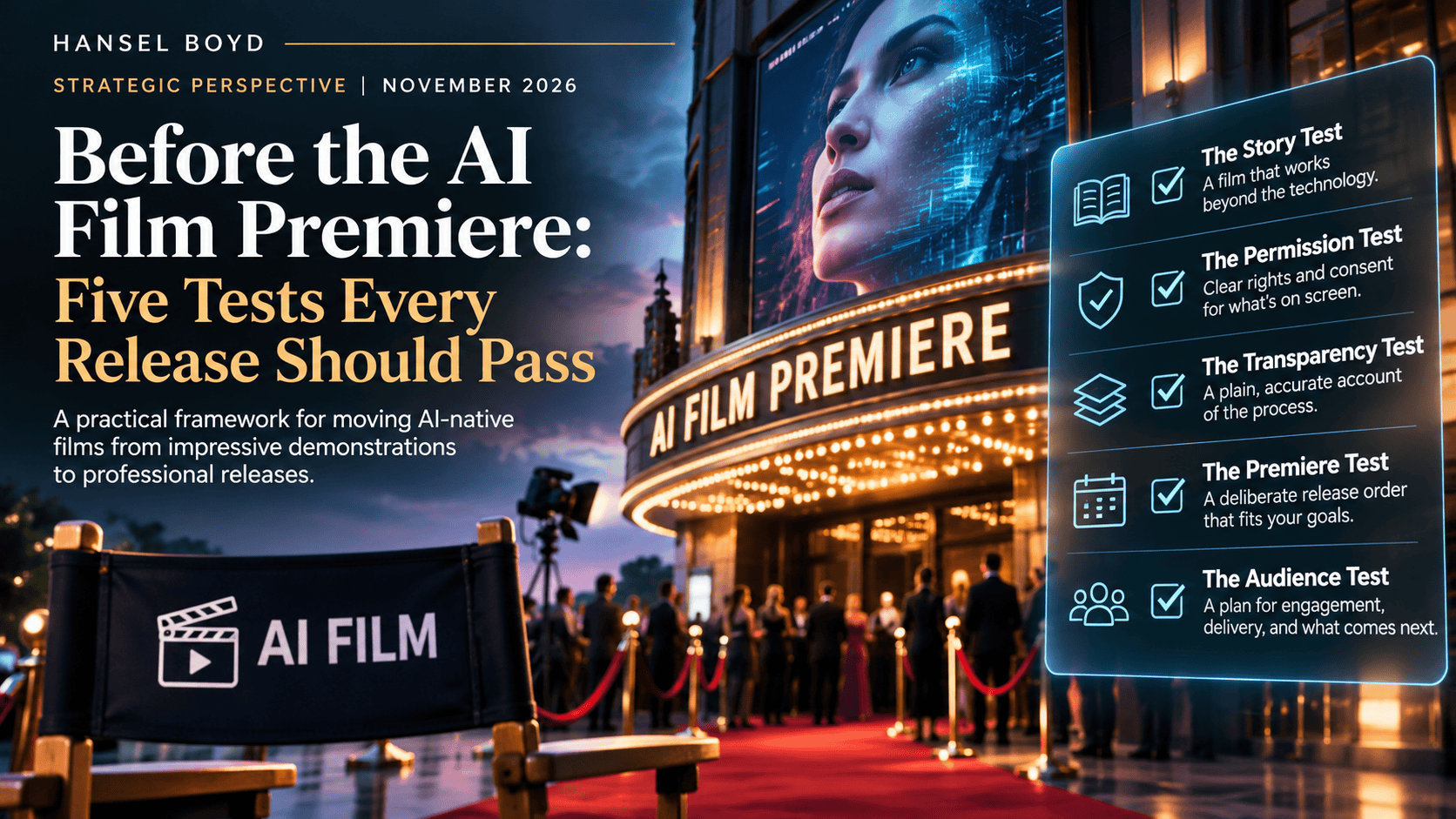
My proposed standard is simple. Before a premiere, an AI-native film should pass five tests.
1. The story test: Would the film work without the technology demonstration?
Show the finished cut to someone who does not know which models were used. Can that viewer explain what the protagonist wants, what changes, and why the ending matters?
Visual novelty can generate the first click. It rarely supplies character motivation, pacing, tension, or emotional consequence. A sequence can be beautifully generated and still fail as a scene. A film can contain many extraordinary scenes and still fail as a story.
Test the actual runtime, not just the trailer. Ask viewers where they disengaged, which moment confused them, and what they remember the next day. Use those findings to revise the edit. The goal is not to prove the technology works. It is to make the work worth watching.
2. The permission test: Can the producer explain the rights behind the finished work?
A release-ready project needs a working record of its underlying materials: scripts, music, footage, trademarks, voices, faces, contributor agreements, and the terms governing material created with AI services. Permission to use a tool does not automatically resolve every third-party right associated with its output.
The U.S. Copyright Office’s January 2025 report explains that copyright protection for AI-involved work depends on sufficient human-authored expression; prompts alone are not necessarily enough. That question is distinct from obtaining consent to use someone’s likeness, clearing a song, or meeting a distributor’s delivery requirements.
Producers should maintain a rights-and-consent ledger: the asset, its source, relevant permission or contract, restrictions, and the person responsible for verification. When material is uncertain, resolve it before calling the film cleared. A beautifully rendered character is not a substitute for documented authorization.
3. The transparency test: Can the filmmaker describe the process plainly?
Audiences do not need a list of every prompt. Buyers and programmers may reasonably need a clear account of where AI was used—in visual generation, voice, music, writing assistance, compositing, or postproduction.
The WAIFF USA production-journal requirement offers one example. YouTube’s disclosure changes offer another. A disclosure is not a verdict on a film’s artistic merit. It is context, and useful context earns more trust when it is accurate, consistent, and easy to find.
Create a one-page production statement before release. Identify the human director or creative lead, describe the material AI contributions, state the permission checks completed, and separate what is verified from what remains under review. Avoid calling any work “certified” unless a real, applicable certification process has occurred.
4. The premiere test: Has the release order been chosen deliberately?
Not every festival treats a public online release the same way. Under the Toronto International Film Festival’s 2026 submission FAQ, a film already publicly available online in North America was ineligible for that year’s festival consideration. By contrast, the WAIFF USA rules for its 2027 event expressly allow prior online distribution and festival screenings.
That contrast matters. Uploading a film publicly may be a smart way to build an audience, or it may close off a particular premiere opportunity. The correct choice depends on the goals and current rules of the programs being targeted—not a universal “festival first” or “online first” formula.
Before release, put the intended sequence in writing: private industry screenings, festival submissions, public premiere, platform exhibition, and any licensing window or territory limitations. Recheck the actual terms when submitting. A release strategy is a sequence of rights and audience decisions, not merely a launch date.
5. The audience test: Is there a plan for what happens after someone presses play?
Every film deserves basic professional delivery: a stable master, watchable sound, captions or subtitles where needed, accurate credits, a concise synopsis, a trailer or still, and a contact point that works. These are mundane details until the wrong export, missing credit, or broken inquiry link costs an opportunity.
Then define the audience. Is the first release meant for festival programmers, genre fans, potential distributors, collaborators, or a wider streaming audience? Success should reflect that goal. Completion rates and repeat viewing may matter for a public screening strategy; qualified inquiries and actual licensing conversations may matter for a business-facing release. A view count by itself proves very little.
Build a small release packet that can travel with the film: the master and trailer, one-sentence logline, synopsis, stills, credits, accessibility information, production statement, rights contact, and intended availability. Make the next step unmistakable.
What this means for the next chapter of AI cinema
My argument is not that every independent creator needs a studio-sized compliance department. It is that the distance between experimentation and exhibition must become manageable. A disciplined small production can keep reliable records, choose its first audience, and provide clear materials without losing its creative independence.
Through work associated with AI Cinema Network and Front Door, I am interested in that transition—from the work being made to the work being meaningfully encountered. Discovery and exhibition only create lasting value when a film is ready to be discovered and exhibited.
The next breakthrough in AI cinema may not be another breathtaking image. It may be the filmmaker who can put a strong story on screen, explain how it was made, demonstrate the necessary permissions, choose the right release path, and give an audience a reason to come back.
That is the standard worth building toward.
Discuss an AI-native release strategy
For advisory, partnerships, or exhibition inquiries, contact Hansel Boyd or explore more perspectives.
Source and scope note: This editorial perspective was prepared November 14, 2026. Festival and platform policies are specific to their organizations and may change. Rights guidance here is strategic commentary, not legal advice.